AI earbuds are changing what you can do with a pair of wireless headphones. They can reduce background noise, make your voice clearer during calls, adjust sound to your surroundings, and even translate conversations between different languages. But here’s something worth knowing: not all of that intelligence actually lives inside the earbuds.
Affiliate Disclaimer
This website participates in affiliate programs. We may earn a commission
when you purchase products through links on this page, at no additional
cost to you. Our recommendations are based on independent research and
honest opinions.
Some AI features run directly on tiny processors inside the earbuds, while others depend on your phone, an app, or cloud-based services. That difference matters because it affects how quickly features respond, whether they work without internet, and which earbuds are worth your money.
Let’s look at how AI earbuds work, what the technology genuinely does, and where it makes a difference in everyday listening.
What Makes AI Earbuds Different From Regular Wireless Earbuds?
Traditional wireless earbuds mainly receive audio from your phone and play it through small speakers. Some also offer active noise cancellation, touch controls, and basic sound adjustments. AI earbuds take those functions further by analyzing audio and responding to changing conditions.
The biggest difference is how they process information. Instead of relying entirely on fixed settings, AI-assisted systems can identify patterns in sound and use those patterns to improve what you hear or what your microphone captures.
You can see that intelligence in several everyday features:
- Adaptive noise cancellation: Adjusts noise reduction according to surrounding sounds and, on some models, your ear fit.
- AI-enhanced calls: Separates your voice from unwanted background noise so conversations sound clearer.
- Live language translation: Converts spoken conversations into another language through connected software.
- Personalized audio: Adjusts sound based on hearing preferences, fit measurements, or listening conditions.
- Voice assistance: Lets you interact with supported assistants through your earbuds without constantly touching your phone.
Of course, having AI on the packaging doesn’t automatically mean every feature works better. The quality of the microphones, audio processing, software, and connected devices still determines how useful the experience feels.
Here’s What Actually Happens When Your Earbuds Use AI
Your earbuds contain microphones, miniature speakers, wireless chips, and digital signal processors. In AI-equipped models, these components work alongside algorithms trained to recognize different types of sounds.
Imagine you’re walking along a busy street while talking to someone on the phone. Your microphones capture a mixture of your voice, passing vehicles, footsteps, and surrounding conversations. The processing system then tries to distinguish the sounds you want from those you don’t.
The basic process looks like this:
- Microphones capture sound. External and internal microphones collect audio from your surroundings or your voice.
- Audio becomes digital information. The system converts incoming sound into signals that software can analyze.
- Algorithms identify patterns. Signal processing and, where supported, machine learning help distinguish speech, noise, and other audio characteristics.
- The system adjusts the output. Your earbuds reduce unwanted noise, process microphone audio, or modify playback.
- The process repeats continuously. The earbuds keep analyzing incoming sound as your surroundings change.
Not every stage requires artificial intelligence. Standard digital signal processing still handles much of the work, particularly in noise cancellation. AI becomes useful when recognizing complicated patterns or adapting to conditions that fixed algorithms cannot handle as effectively.
Your Earbuds Don’t Always Do the AI Processing Themselves
This is one of the most important things to understand before spending money on AI earbuds.
Small earbuds have limited processing power and battery capacity. They can handle many audio tasks locally, but more demanding functions often rely on a connected smartphone or remote servers.
There are three common processing arrangements.
On-device AI Handles Fast Audio Adjustments
Some processing happens inside the earbuds themselves. This is especially useful for real-time noise reduction, microphone processing, and sound adjustments that need a quick response.
Local processing can also work without an internet connection. However, the exact capabilities depend on the hardware and software built into each model.
Your Smartphone Takes Care of More Complicated Tasks
A connected phone can perform heavier processing while the earbuds act as microphones and audio output devices. Translation is a good example because speech recognition, language processing, and voice generation require more computing resources than ordinary audio playback.
Samsung’s Galaxy AI Interpreter demonstrates this approach. A compatible Galaxy phone handles the Interpreter feature, while connected Galaxy Buds deliver translated speech into your ears.
Cloud AI Can Handle Even Larger Tasks
Some apps send audio or text to online services for recognition, translation, or AI assistant responses. Cloud processing can support complex models without requiring powerful processors inside your earbuds.
The downside is that internet connectivity, server response times, and privacy policies become important. If your connection drops, certain features may become unavailable or less capable.
How AI Makes Noise Cancellation and Phone Calls Better
Noise cancellation is probably the AI-related feature you’ll notice most often. It can make commuting, working in a coffee shop, or listening to music in a noisy environment considerably more comfortable.
Traditional active noise cancellation uses microphones to detect outside noise and produces an opposing sound wave to reduce what reaches your ears. It works particularly well against steady, low-frequency sounds such as airplane engines or air conditioners.
Adaptive systems add another layer of control. They analyze changing conditions and adjust how aggressively noise is reduced, sometimes accounting for your ear fit or the acoustic environment.
AI can also improve call quality, although call noise reduction works differently from ANC. Instead of reducing the noise you hear, microphone processing focuses on making your voice easier for someone else to understand.
These improvements matter in a few familiar situations:
- During commutes: Adaptive ANC can reduce continuous traffic and engine noise.
- In busy offices: Microphone processing can make your speech clearer during calls.
- While walking outdoors: Some systems adjust ambient sound so you remain aware of your surroundings.
- In windy conditions: Wind-noise reduction can help prevent microphone recordings from becoming overwhelmed.
Keep in mind that AI cannot completely eliminate every unwanted sound. Sudden noises, strong wind, and overlapping voices remain difficult, especially when your earbuds don’t fit properly.
How Real-Time AI Translation Works Through Your Earbuds
Real-time translation is where AI earbuds start to feel very different from ordinary wireless headphones.
Suppose you’re traveling abroad and someone gives you directions in a language you don’t understand. With compatible translation earbuds and software, you can hear an interpreted version of their speech without manually typing every sentence into a translation app.
Most AI translation systems follow three main steps:
- Speech recognition: The software listens to spoken words and converts them into text or another internal representation.
- Machine translation: A language model or translation system converts the original meaning into your chosen language.
- Speech synthesis: Text-to-speech technology generates audio that you hear through the earbuds.
All of this can happen quickly, but real-time doesn’t necessarily mean instantaneous. The system may need to wait for enough context to understand a sentence before producing a reliable translation.
Accents, slang, technical language, background noise, and people speaking over each other can also affect accuracy. That’s why translation earbuds are useful for everyday communication but shouldn’t be your only source of interpretation for important medical, legal, or emergency conversations.
Two AI Earbuds That Show How Different This Technology Can Be
Now that you know what’s happening behind the scenes, the product differences become easier to understand.
Some earbuds focus on sound quality, noise cancellation, and AI features integrated with your smartphone. Others put language translation first and use a companion app to provide those functions at a much lower price.
The following two options represent those different approaches. Their advertised prices are useful reference points, although actual Amazon prices can change.
1
Samsung Galaxy Buds4 Pro Review: Best for Everyday AI Audio

The Samsung Galaxy Buds4 Pro make sense if you want AI features to improve the earbuds you already use for music, calls, and everyday listening. They’re not simply a translation gadget. Samsung combines its audio hardware with adaptive processing and Galaxy AI services that work through compatible devices.
The earbuds feature a two-way speaker system with a tweeter and woofer, along with high-resolution audio support on compatible Galaxy hardware. Their Adaptive ANC 2.0 also processes changing noise conditions in real time, which should be useful if your surroundings regularly shift between quiet and noisy.
Live translation is another important feature. When paired with a supported Galaxy phone, you can hear interpreted speech through the earbuds and use Samsung’s Interpreter or Live Translate features. However, those capabilities depend on the phone and software, rather than translation happening independently inside the earbuds.
A few details make them especially appealing:
- Adaptive ANC 2.0: Adjusts noise cancellation as listening conditions change.
- Two-way speakers: Separate drivers handle different audio frequencies.
- Galaxy AI integration: Supports Interpreter and Live Translate on compatible Samsung devices.
- IP57 resistance: Provides dust protection and water resistance for the earbuds, but not the case.
- Galaxy ecosystem features: Offers additional controls and device switching with compatible Samsung hardware.
The biggest consideration is compatibility. You can use the Buds4 Pro as Bluetooth earbuds with other devices, but several advanced functions, including Galaxy AI translation, are restricted to supported Galaxy phones. Samsung confirms those differences in its compatibility guidance.
At around $250, these are a substantial investment. I’d consider them if you already own a compatible Galaxy phone and care more about music, calls, and noise cancellation than translation alone.
2
Csasan AI Translation Earbuds Review: Best for Affordable Translation
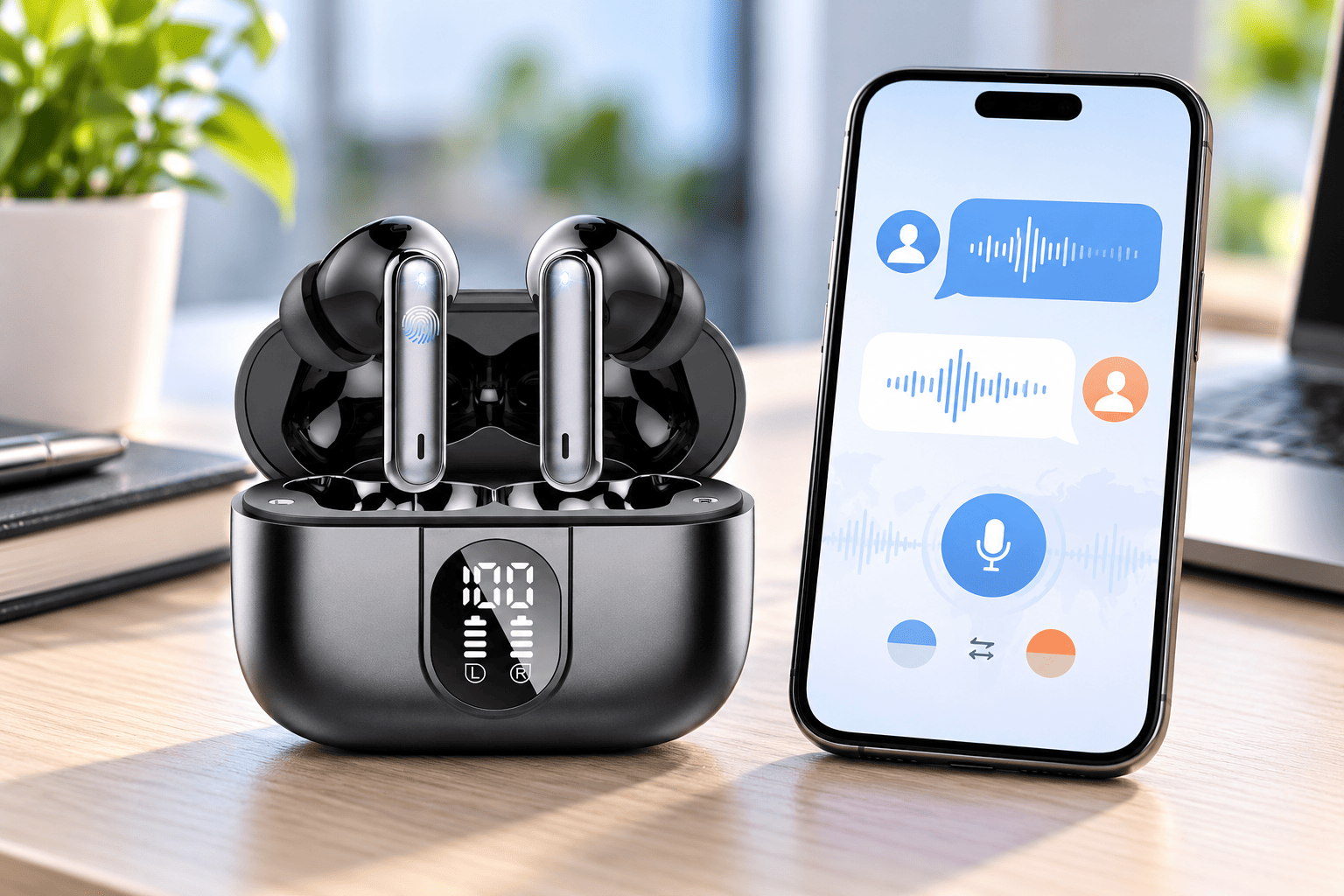
The Csasan Real-Time AI Translation Earbuds take a different approach. Their main attraction is language translation rather than sophisticated music playback or adaptive ANC. The listing advertises 165 languages, six translation modes, an AI chat feature, and no required subscription.
That combination sounds appealing if you’re preparing for international travel or regularly communicating with people who speak different languages. You still need to remember that the intelligence largely comes from companion software, so app quality matters just as much as the earbuds themselves.
These earbuds are advertised with simultaneous interpretation, support for audio and video call translation, and several conversation modes. The product is identified as the Csasan J90 Pro, and available listings describe an app-based system for accessing its translation features.
Here are the main advertised features:
- 165-language support: A broad claimed language selection, although available modes and accuracy may vary.
- Six translation modes: Intended for different conversation and interpretation situations.
- AI chat mode: Provides access to an AI assistant function through companion software.
- No subscription claim: Advertised without a recurring translation subscription.
- 40-hour battery claim: The advertised total should be checked against actual per-charge playback and translation use.
The price makes these interesting, especially compared with more expensive AI earbuds. Still, I wouldn’t assume a claimed one-second response or support for 165 languages guarantees accurate translations in every situation.
There’s also a difference between ordinary Bluetooth compatibility and translation-app compatibility. Before ordering, check whether the companion app supports your phone, whether your preferred languages require internet access, and whether any particular translation modes have additional restrictions.
At the listed $29.99, they’re worth considering as an affordable translation-focused option. Just approach the advertised specifications as claims rather than independently proven performance.
The AI Features That Actually Matter Before You Buy
It’s easy to get distracted by large language counts or impressive AI terminology. What matters more is whether the functions solve problems you regularly face.
Here are the details I’d check before choosing any pair of AI earbuds.
1. Phone compatibility matters more than the AI label
Your phone determines which features you can actually use. A pair of earbuds might connect to almost any Bluetooth device while reserving its most advanced functions for specific phones or operating systems.
2. Translation accuracy matters more than language count
Support for 165 languages sounds impressive, but reliable translation between the two languages you actually speak is more valuable. Pay attention to common conversation accuracy, response delays, and offline support.
3. Microphone quality affects almost everything
Clear microphone audio makes speech recognition, translation, and phone calls easier. Even capable AI software struggles when wind or background conversations overwhelm the original voice.
4. Battery ratings need some context
Manufacturers often advertise total battery life with the charging case. Continuous translation, active noise cancellation, and microphone processing may use more power than ordinary music playback.
5. Privacy deserves attention
An app-based translator may process conversations on remote servers. Check microphone permissions, recording retention, and data policies before using these tools for personal or confidential discussions.
6. Comfort still matters
AI features won’t make uncomfortable earbuds pleasant to wear. Ear-tip size, weight, stability, and pressure inside your ears remain important, especially if you plan to wear them for long conversations or flights.
Is AI in Earbuds Really Worth Paying Extra For?
AI earbuds are worth considering when their features fit your daily routine. If you spend hours on calls, reliable voice processing could be more useful than an additional music preset. If you travel internationally, convenient translation might be the feature that makes the purchase worthwhile.
However, not every advertised AI function requires expensive earbuds. Translation apps already perform many language-processing tasks on smartphones, and some affordable earbuds can simply serve as the listening device.
The real question is whether a particular pair improves the experience enough to justify its price.
For Samsung Galaxy owners who want a capable everyday audio product, the Buds4 Pro offer a broader combination of sound features and ecosystem integration. For someone primarily curious about translation, the Csasan model offers a much lower-priced way to try that category, provided the app supports their needs.
Final Thoughts: AI Earbuds Are Useful When the Technology Fits Your Life
AI inside your earbuds isn’t a tiny chatbot doing everything on its own. It’s a combination of microphones, digital signal processing, machine learning, smartphone software, and sometimes cloud services working together to make listening and communication easier.
That’s why understanding where the processing happens matters. It helps you separate genuinely useful technology from features that sound impressive but depend heavily on another device or service.
If you already use a compatible Samsung Galaxy phone and want better everyday audio with AI-assisted features, I’d lean toward the Samsung Galaxy Buds4 Pro. If your main interest is experimenting with real-time language translation at a lower cost, the Csasan AI Translation Earbuds are the more affordable option to investigate.
Ultimately, the best AI earbuds aren’t necessarily the ones advertising the most intelligence. They’re the ones that make something you already do feel noticeably easier.