Open-back headphones generally sound more spacious and natural, while closed-back headphones provide better noise isolation and privacy. If you mostly listen to music or play games in a quiet room, open-back headphones can make the experience feel more immersive. But if you travel, work around other people, or need to block background noise, closed-back headphones are usually the more practical choice.
Affiliate Disclaimer
This website participates in affiliate programs. We may earn a commission
when you purchase products through links on this page, at no additional
cost to you. Our recommendations are based on independent research and
honest opinions.
The difference comes down to how the ear cups are built. That small design detail affects everything from soundstage and bass response to comfort and sound leakage.
I’ll explain how both designs work, where each one performs better, and why affordable open-back models like the Philips SHP9600 and SHP9500 are worth considering for home listening.
What Makes Open-Back and Closed-Back Headphones So Different?
The main difference is whether the back of each ear cup allows air and sound to pass through.
Open-back headphones have vents, grilles, or perforations behind their speaker drivers. These openings let air move more freely, which can reduce certain acoustic reflections and create a more spacious listening experience.
Closed-back headphones use solid ear cups that separate the inside of the headphones from your surroundings. This construction helps contain the sound and reduces the amount of outside noise reaching your ears.
Here’s what that means in everyday use:
- Open-back headphones: Usually offer a wider, more natural soundstage with greater airflow around your ears.
- Closed-back headphones: Provide better sound isolation, less leakage, and a more private listening experience.
- Open-back designs: Work particularly well in quiet rooms where outside noise isn’t a problem.
- Closed-back designs: Make more sense for commuting, shared offices, recording sessions, and other noisy environments.
Neither design automatically guarantees better sound quality. Driver performance, tuning, ear pads, and overall construction still play major roles in how good a pair of headphones sounds.
Why Open-Back Headphones Often Sound More Natural and Spacious
One reason people enjoy open-back headphones is their soundstage. That’s the perceived space where instruments, vocals, and other sounds appear around you.
With some closed-back headphones, music can feel relatively close to your head. Open-back designs often create a greater sense of separation, making instruments seem positioned across a wider listening area.
Imagine listening to a live jazz recording. With a good open-back pair, you may hear the piano toward one side, the drums in another position, and the vocals clearly centered between them.
Several characteristics contribute to this experience:
- Reduced internal reflections: The open ear cups allow sound energy to escape rather than reflecting entirely inside an enclosed space.
- More spacious presentation: Well-designed open-back headphones can make stereo recordings feel less confined.
- Clearer instrument separation: A spacious soundstage can make individual musical elements easier to distinguish.
- Natural midrange reproduction: Many open-back models are tuned to present vocals and instruments without excessive bass emphasis.
However, open-back doesn’t automatically mean a wider soundstage or better accuracy. Some closed-back headphones reproduce spatial details extremely well, while inexpensive open-back models can still have noticeable tuning problems.
The quality of the individual headphone matters more than the label alone.
Closed-Back Headphones Have One Major Advantage: Better Isolation
Closed-back headphones become much more appealing when your surroundings aren’t quiet.
Their enclosed ear cups act as a physical barrier between your ears and outside noise. This is called passive noise isolation, and it works without batteries or electronic noise cancellation.
If you’re sitting near someone talking, working in a shared office, or traveling on a train, that physical separation can make listening considerably easier.
Closed-back headphones also have several practical advantages:
- Less sound leakage: People nearby are less likely to hear your music.
- Better background noise reduction: Ear cups help block conversations and environmental sounds.
- More consistent bass in noisy places: A good ear-pad seal helps preserve low frequencies.
- Greater privacy: You can listen without sharing every detail of your playlist with the room.
- More travel-friendly options: Many closed-back headphones feature folding designs, Bluetooth connectivity, or active noise cancellation.
Some closed-back headphones also include active noise cancellation, which electronically reduces certain outside sounds. Open-back headphones generally aren’t designed for that kind of isolation.
The tradeoff is that sealed ear cups can trap heat and create a more enclosed feeling during longer listening sessions.
Sound Quality, Bass, and Comfort: Where Each Design Performs Better
Sound quality isn’t simply a contest between open and closed ear cups. Each construction changes how the headphone interacts with air, sound pressure, and your ears.
Open-back headphones frequently emphasize spaciousness and natural presentation, while closed-back designs can produce stronger perceived bass impact and better isolation.
Here’s how those differences affect actual listening.
Bass Response Depends on More Than the Ear Cup Design
Closed-back headphones can produce satisfying bass because their sealed construction helps maintain acoustic pressure. This makes them appealing for electronic music, hip-hop, and other genres where low-frequency impact matters.
Open-back headphones can also deliver excellent bass, but some models have less sub-bass extension or physical impact. Their open construction can make deep bass reproduction more challenging.
That doesn’t mean closed-back headphones always have better bass. Driver quality, tuning, and ear-pad fit remain important, and a well-designed open-back model can outperform a poorly tuned closed-back pair.
Open-Back Headphones Often Feel Better During Long Sessions
Comfort is another reason to consider open-back headphones, especially if you spend hours listening at home.
The ventilated ear cups allow more airflow, which can reduce the warm, enclosed feeling associated with some closed-back models. That difference becomes useful during long gaming sessions or extended music listening.
Still, comfort also depends on weight, clamping force, headband padding, and ear-cup dimensions. An uncomfortable open-back headphone won’t suddenly feel comfortable just because it has ventilation.
Sound Leakage Is the Biggest Compromise
Open-back headphones let sound travel in both directions. You can hear more of your surroundings, and people sitting nearby may hear your music.
For private listening in a bedroom, that may not matter. In a library, shared office, or quiet apartment, it could quickly become frustrating.
Closed-back headphones are generally better when you need to keep your listening private, although leakage varies between individual models.
Open-Back or Closed-Back: Which Works Better for Gaming and Recording?
Gaming is one of the most interesting uses for open-back headphones. Their spacious presentation can make virtual environments feel more convincing, particularly when games have good positional audio.
You may find it easier to appreciate environmental details, directional sounds, and the distance between different sound sources.
However, open-back headphones aren’t automatically better for competitive gaming. Accurate imaging, driver tuning, and the game’s audio processing matter just as much as soundstage width.
If you play in a quiet bedroom, open-back headphones are worth considering. But if people regularly talk nearby or your computer setup is noisy, closed-back headphones can help you concentrate.
Recording presents another important difference.
For music production and recording:
- Mixing and critical listening: Open-back headphones are popular because of their spacious presentation and potential for accurate sound reproduction.
- Vocal recording: Closed-back headphones are usually preferable because less playback audio escapes into the microphone.
- Podcast recording: Closed-back designs reduce the risk of headphone sound leaking into sensitive microphones.
- Instrument practice: Either type can work, depending on whether you need isolation or want to remain aware of your surroundings.
The distinction matters because the headphones that work well for mixing aren’t necessarily ideal for recording vocals. Audio engineers often use both types for different stages of production.
Two Philips Open-Back Headphones Worth Considering for Home Listening
If you’ve decided that open-back headphones fit your listening habits, Philips offers two interesting wired models at relatively accessible prices.
The SHP9600 and SHP9500 both use open-back construction, 50 mm drivers, and detachable cables. However, they have different tuning characteristics and slightly different approaches to comfort and everyday listening.
Neither is intended to isolate you from outside noise. These are headphones worth considering when you want to enjoy music, games, or detailed audio in a relatively quiet environment.
1
Philips SHP9600 Review: Best for Comfortable Everyday Listening
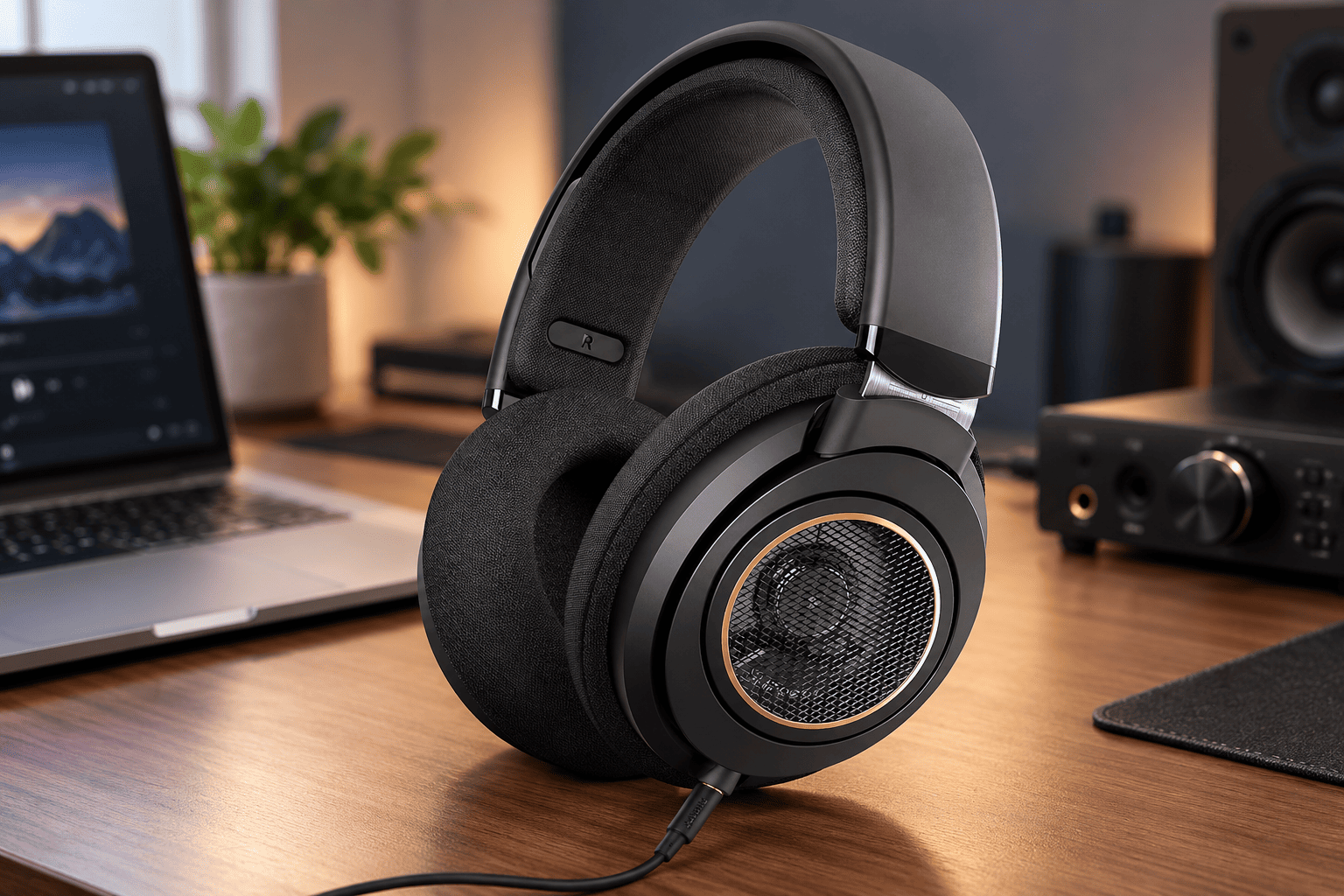
The Philips SHP9600 Open-Back Headphones are a reasonable starting point if you’re curious about open-back sound without spending several hundred dollars. At the listed price of $67.98, they offer a wired over-ear design with large drivers, breathable ear cushions, and a detachable audio cable.
Philips uses 50 mm neodymium drivers and an open acoustic system intended to deliver a spacious presentation. The headphones have a 32-ohm impedance, making them suitable for many ordinary headphone outputs without requiring a dedicated high-powered amplifier.
The SHP9600’s tuning is generally aimed at a warmer, fuller listening experience rather than an extremely lean or analytical sound. That character can make casual music listening enjoyable, particularly if you appreciate some bass presence without giving up the benefits of an open-back design.
Comfort is another important part of their appeal. Philips includes a reinforced headband with double-layer cushioning and breathable fabric ear pads. The headphones weigh approximately 292 grams, so they aren’t unusually heavy for full-size over-ear headphones.
Some useful features include:
- 50 mm neodymium drivers: Provide the foundation for the headphones’ stereo sound.
- Open-back ear cups: Allow a more spacious presentation and greater airflow.
- 32-ohm impedance: Makes them relatively practical with common audio devices.
- Detachable 3-meter cable: Useful for desktop computers and home audio equipment.
- 6.3 mm adapter: Supports compatible audio interfaces and headphone amplifiers.
- Breathable fabric cushions: Intended to improve comfort during extended listening.
The main limitation is their lack of isolation. You won’t get meaningful protection from nearby conversations, and your music will be audible to people sitting close to you.
The long cable is useful at a desk but may feel inconvenient when connecting to a phone or laptop on the move.
If you want an affordable open-back headphone for relaxed music listening, home gaming, or general desktop use, the SHP9600 makes sense. Its combination of comfort-focused construction and approachable pricing gives it a clear place in this category.
2
Philips SHP9500 Review: Best for Detailed Music and Critical Listening
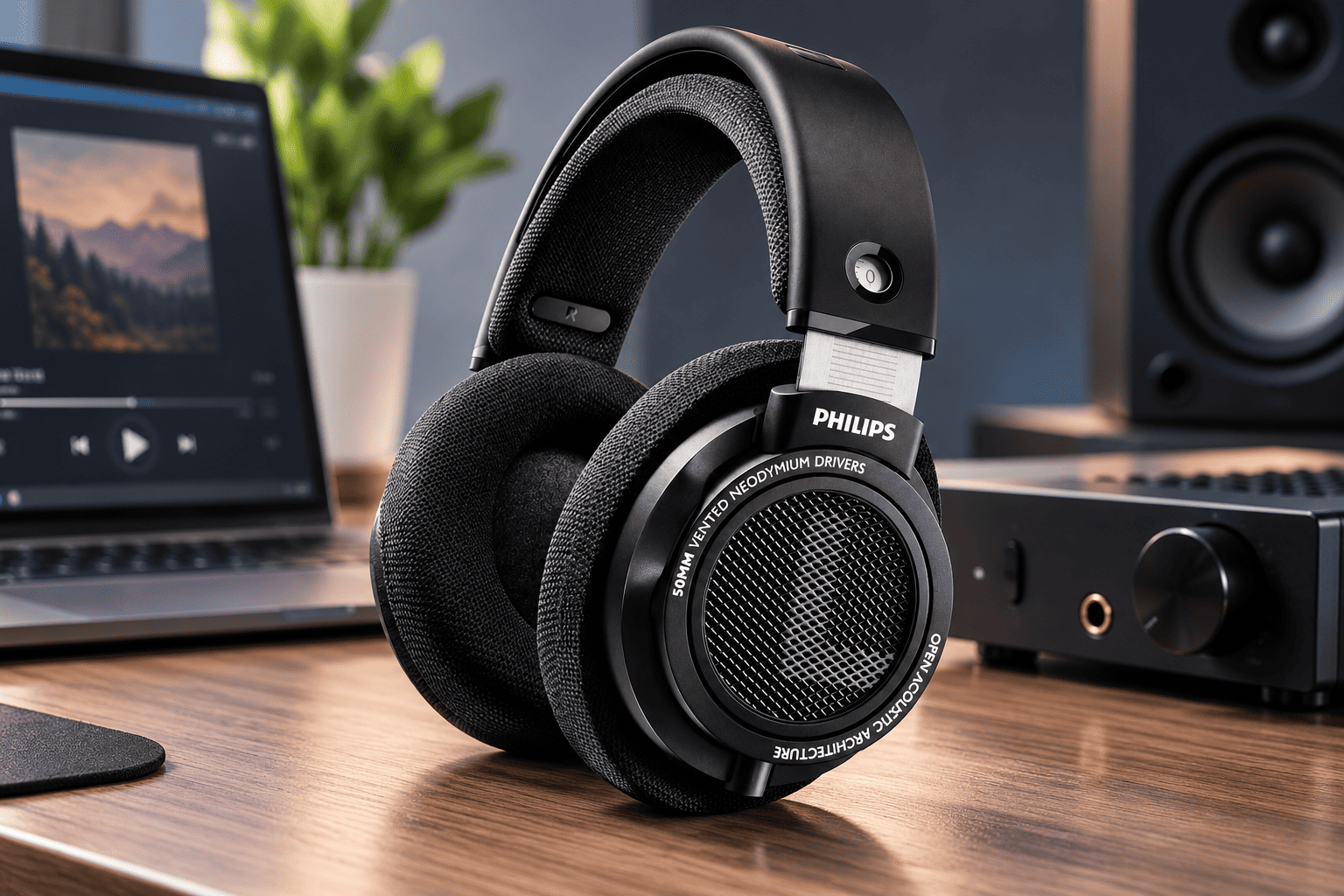
The Philips SHP9500 HiFi Precision Stereo Headphones are another option if you want an open-back design with a more clarity-focused sound presentation. At the listed price of $84.98, they’re somewhat more expensive than the SHP9600, but they appeal to a slightly different listening preference.
The SHP9500 uses 50 mm neodymium drivers and an open acoustic system. Philips also positions the drivers at an angle intended to align more naturally with your ears, supporting a spacious listening experience.
Compared with the SHP9600, the SHP9500 is generally associated with a brighter, more neutral-leaning presentation. That can make vocals, acoustic instruments, and subtle recording details particularly interesting, although treble-sensitive listeners may prefer a warmer headphone.
If you enjoy hearing individual instruments in a recording, the SHP9500 is worth considering. Its open construction can make music feel less confined, while its sound character places more attention on clarity than heavy bass impact.
The headphones also have a 32-ohm impedance and a detachable 3-meter cable, so they work with many home audio setups without demanding specialized equipment.
Here’s what stands out:
- Open-back acoustic design: Encourages a spacious sound presentation.
- 50 mm neodymium drivers: Designed for detailed stereo reproduction.
- Angled drivers: Intended to direct sound naturally toward your ears.
- 32-ohm impedance: Suitable for many standard headphone outputs.
- Detachable cable: Provides replacement flexibility and compatibility with other suitable cables.
- Breathable ear cushions: Make extended home listening more comfortable.
Like the SHP9600, these headphones offer very little isolation. They’re not a practical choice for commuting or situations where you need to keep your music private.
Their relatively restrained bass emphasis may also disappoint you if your favorite music relies heavily on deep, physical low-frequency impact.
I’d consider the SHP9500 if you value clarity, acoustic detail, and spacious sound over heavy bass. They’re especially interesting for dedicated music listening in a quiet room.
Philips SHP9600 vs SHP9500: Which One Makes More Sense?
Since both headphones share the same basic open-back construction, the decision largely comes down to their sound signatures, comfort preferences, and pricing.
The SHP9600 takes a warmer approach that may suit relaxed listening, while the SHP9500 leans toward a brighter, more detail-focused presentation.
Here are the practical differences worth considering:
- For relaxed music listening: The SHP9600 is a sensible choice if you prefer a slightly fuller, warmer sound.
- For acoustic music and vocal clarity: The SHP9500 may appeal more if you enjoy hearing subtle details.
- For long desktop sessions: Both have breathable cushions, although individual fit and clamping pressure will determine comfort.
- For home gaming: Either can work well, but positional accuracy depends on more than soundstage width alone.
- For budget-conscious listening: The SHP9600 costs less at the provided prices, making it the more affordable starting point.
- For private or noisy environments: Neither is ideal because both use open-back ear cups.
The approximately $17 price difference isn’t enormous, so I’d focus more on your preferred sound than the small difference in cost.
Also, neither model requires a high-end amplifier for basic use, although the quality and output of your audio source can still affect the overall experience.
What Actually Matters Before Choosing Open-Back or Closed-Back Headphones?
Before deciding which headphone design to buy, think about where you’ll use it most often.
A headphone that sounds excellent in a quiet bedroom can become frustrating on a crowded train. Similarly, a closed-back travel headset may be convenient outside but feel less airy during long listening sessions at home.
I’d focus on these practical considerations.
1. Your listening environment
If your room is usually quiet, open-back headphones become much more appealing. If background noise is unavoidable, closed-back models will generally offer a better experience.
2. The people around you
Open-back headphones leak sound. If you share a workspace or frequently listen near someone sleeping, closed-back headphones are the more considerate choice.
3. Your preferred sound presentation
If you enjoy a spacious, natural soundstage, open-back headphones deserve attention. If you prefer strong isolation and a more intimate presentation, closed-back models may suit you better.
4. Your favorite music
Both designs can reproduce every music genre well, but individual tuning matters. Don’t assume open-back always means weak bass or closed-back always means muddy sound.
5. Comfort during long sessions
Pay attention to ear-pad materials, headphone weight, headband pressure, and ventilation. Open-back models can feel cooler, but comfort varies considerably between products.
6. Your recording or gaming needs
For critical listening in quiet rooms, open-back designs can be useful. For microphone recording, travel, or gaming in noisy environments, closed-back headphones are often more practical.
There’s no need to spend extra on a specific construction type simply because it’s popular among audio enthusiasts. The best choice is the one that works well in the environment where you’ll actually listen.
Final Thoughts: Which Headphone Type Should You Buy?
Open-back headphones are worth buying if you primarily listen at home, enjoy spacious sound, and don’t need isolation from the outside world. They can make music and games feel more natural, particularly when you have a quiet place to enjoy them.
Closed-back headphones are the better choice for commuting, office work, recording vocals, and listening around other people. Their ability to reduce sound leakage and outside distractions makes them more versatile for everyday use.
Among the two Philips models, I’d recommend the SHP9600 if you want a warmer, comfortable open-back headphone at a lower price. The SHP9500 makes more sense if you’re willing to spend slightly more for a brighter, detail-focused listening experience.
Just remember that both are open-back headphones. If you need privacy, noise isolation, or headphones for frequent travel, I’d choose a suitable closed-back model instead.
The important thing isn’t which design is considered more audiophile. It’s which one makes your music, games, and everyday listening more enjoyable in the places you actually use it.