Optical zoom uses a camera’s lens system to capture a closer view of your subject, while digital zoom enlarges part of an image through cropping and processing. Both can make distant objects appear bigger, but optical magnification generally preserves more useful detail when compared with cropping the same camera image.
Affiliate Disclaimer
This website participates in affiliate programs. We may earn a commission
when you purchase products through links on this page, at no additional
cost to you. Our recommendations are based on independent research and
honest opinions.
That’s why a phone with a dedicated telephoto camera can produce sharper distant subjects than one relying entirely on digital zoom. However, modern smartphones also use high-resolution sensors and computational photography to improve digital zoom, so the difference isn’t always obvious at lower magnifications.
If you enjoy photographing concerts, wildlife, travel destinations, or everyday moments, understanding these differences can help you get better pictures without chasing impressive zoom numbers. I’ll also explain how external smartphone lenses work and whether they’re worth adding to your camera setup.
What Optical Zoom Actually Does Inside Your Phone Camera
Optical zoom changes the image magnification through the camera’s optics before light reaches the sensor. Instead of simply enlarging an existing image, the optical system captures a narrower or wider field of view.
Traditional zoom lenses achieve this by moving optical elements to change focal length. Most smartphones, however, use separate cameras with different fixed focal lengths, switching between them as you tap different zoom levels.
For example, a smartphone might have a main camera, an ultrawide camera, and a dedicated 5x telephoto camera. Selecting 5x can switch to the telephoto module, allowing the camera to capture a closer view optically.
That’s different from taking a photograph with the main camera and cropping it afterward.
Here’s why optical magnification can be useful:
- More actual subject detail: A telephoto lens can project a larger image of a distant subject onto its sensor.
- Better distant framing: You can photograph subjects without physically moving closer.
- Less dependence on cropping: Optical magnification reduces the need to discard pixels from a wider image.
- Different perspectives and compositions: Telephoto framing can help isolate subjects and emphasize distant details.
- More flexibility for photography: Dedicated optical focal lengths give you additional choices when composing shots.
However, optical zoom doesn’t guarantee better results in every situation. Sensor size, aperture, lens sharpness, stabilization, and available light still determine how well a particular telephoto camera performs.
Digital Zoom Explained: How Your Phone Enlarges an Image
Digital zoom works differently because it doesn’t require the camera lens to change its optical magnification.
Instead, your phone selects a smaller portion of the image captured by its sensor and enlarges that area to fill the final photograph.
Imagine taking a normal picture of a bird sitting in a tree. If you crop the photograph around the bird and enlarge the result, you’ve performed something similar to basic digital zoom.
Your phone can do this automatically when you pinch the screen or select a magnification level beyond its available optical focal lengths.
Digital zoom typically involves three processes:
- Cropping: The camera selects a smaller section of the captured image.
- Resizing: Software enlarges that section to the desired output dimensions.
- Image processing: Sharpening, noise reduction, and sometimes AI-assisted reconstruction improve the appearance of the enlarged image.
The limitation is that cropping reduces the amount of original image information available.
For example, if you crop a 12-megapixel image to half its original width and height, only about 3 megapixels of captured information remain.
Your phone can enlarge the image back to 12 megapixels, but those additional output pixels don’t automatically represent newly captured detail.
Modern computational photography makes this more complicated, though. Some phones combine multiple frames, use high-resolution sensor crops, or apply advanced reconstruction to improve the final result.
That’s why a modest amount of digital zoom can still look surprisingly good.
Why Optical Zoom Usually Produces Sharper Distant Photos
The biggest advantage of optical magnification is that it can capture more information about a distant subject before the image reaches the processing stage.
Digital zoom generally works with the information already captured by the camera.
Imagine photographing a performer from the back of a concert venue.
With a dedicated telephoto camera, the performer’s face occupies a larger portion of the sensor image. That gives the camera more opportunity to record details such as facial features and clothing textures.
With digital zoom from a wider camera, the performer occupies a smaller portion of the original image. Enlarging that section makes the subject look bigger, but it cannot reliably reproduce details that weren’t captured.
You may notice differences in several areas:
- Fine details: Optical telephoto images can retain more genuine texture at longer distances.
- Text and patterns: Small lettering and distant objects may remain more recognizable.
- Image sharpness: Heavy digital cropping can make softness and noise more obvious.
- Editing flexibility: Images with more captured subject detail generally tolerate cropping better.
- Low-light performance: Results depend heavily on the sensor and lens, not just whether the magnification is optical.
One important exception involves high-resolution smartphone cameras.
A phone with a 48-megapixel main sensor, for example, may produce a useful 2x crop from its central pixels. Under suitable lighting, this can look better than using a small, slower dedicated telephoto camera.
So, optical zoom has a real advantage, but you still need to judge the complete camera system.
Why Your Phone Can Advertise 30x or 100x Zoom
Smartphone manufacturers often advertise extremely large zoom ranges, but those numbers don’t necessarily represent optical magnification.
A phone advertising 100x zoom may use a combination of telephoto optics, sensor cropping, digital enlargement, and computational processing.
The optical system provides the starting image. Software handles magnification beyond the camera’s native optical capabilities.
This is often called hybrid zoom.
Hybrid systems can combine information from different cameras and multiple frames to produce better images than straightforward digital cropping alone.
However, the final quality still depends on how much genuine detail the camera captured.
It’s useful to distinguish three terms:
- Optical magnification: Uses lens optics or a dedicated telephoto camera to capture a closer view.
- Digital zoom: Enlarges a cropped portion of the captured image through software.
- Hybrid zoom: Combines optical capabilities with digital cropping and computational processing.
The advertised zoom number alone doesn’t tell you how sharp the photograph will look.
A well-designed 5x telephoto camera may produce more useful images at moderate distances than a phone advertising extreme digital magnification without comparable optical hardware.
When Digital Zoom Is Actually Good Enough
Digital zoom isn’t useless. In fact, it’s often the quickest way to improve framing when you don’t need maximum image quality.
Suppose you’re photographing a street sign, a building, or a friend standing a short distance away.
A modest 1.5x or 2x crop may produce an excellent result, particularly when you’re shooting in bright daylight with a modern high-resolution smartphone.
You may not notice a meaningful quality difference when viewing the photograph on a phone screen or sharing it through social media.
Digital zoom becomes especially practical in these situations:
- Casual photography: Small crops are usually sufficient for everyday pictures.
- Social media sharing: Reduced display sizes can make minor quality losses difficult to notice.
- Good lighting: Bright conditions allow the sensor to capture cleaner details.
- High-resolution cameras: Additional native pixels provide greater cropping flexibility.
- Quick framing adjustments: Digital zoom lets you change composition without moving.
The problems become more obvious at extreme magnification.
If you repeatedly enlarge a small section of an image, fine details begin to disappear. Noise, blur, and artificial sharpening can also become more noticeable.
For everyday photos, I’d use digital zoom when it produces the composition I want. For distant subjects where detail matters, I’d prioritize a good optical telephoto option.
Zoom Quality Depends on More Than Optical vs Digital
It’s tempting to assume that any optical lens will outperform digital zoom, but photography isn’t quite that simple.
A poorly designed telephoto attachment can introduce softness and distortion. A modern smartphone using computational zoom may sometimes produce a cleaner image than a low-quality optical accessory.
Several factors affect the final result.
Sensor size and resolution: A larger or higher-resolution sensor can provide more usable information, although the benefits depend on lighting and sensor technology.
Lens sharpness: Good optics preserve fine details before the camera processes the image. Weak optics can limit resolution even when magnification is high.
Image stabilization: Longer focal lengths exaggerate small movements. Stabilization becomes increasingly important when photographing distant subjects.
Available light: Telephoto cameras often have smaller apertures than main smartphone cameras, which can make low-light photography more challenging.
Computational processing: Modern phones combine frames, reduce noise, and enhance details. These techniques can improve zoom images, although they have limitations.
The best zoom camera isn’t necessarily the one with the highest number. It’s the one that provides usable detail at the magnifications you actually need.
Can a Clip-On Lens Give Your Phone Real Optical Magnification?
Yes, a compatible external telephoto lens can change how your smartphone captures distant subjects. Instead of relying entirely on software cropping, the attachment uses physical optics to magnify the scene before light reaches your phone’s sensor.
That can be useful if your smartphone doesn’t have a dedicated telephoto camera or if you want greater optical reach than its built-in lenses provide.
However, there’s an important difference between a fixed telephoto attachment and a true optical zoom lens. Most clip-on telephoto lenses offer fixed magnification rather than an adjustable optical zoom range.
These accessories also introduce practical limitations:
- Camera alignment: The attachment must sit directly over the intended camera lens.
- Image stability: Higher magnification makes small hand movements more noticeable.
- Optical quality: Additional glass can introduce softness, reflections, and color fringing.
- Phone compatibility: Large camera bumps and automatic lens switching can complicate installation.
- Portability: External lenses add weight and require more setup than your phone’s built-in camera.
And remember, a macro attachment serves a different purpose. It helps capture small subjects at close distances, not distant objects.
That distinction becomes especially important when comparing products advertising similar magnification numbers.
Two Smartphone Lens Kits for Different Photography Needs
The APEXEL Tele-Macro Pro and Ailun 3-in-1 Lens Kit both give your smartphone additional optical options, but they aren’t direct alternatives for long-distance photography.
APEXEL focuses on strong telephoto magnification and close-up shooting. Ailun offers wide-angle, fisheye, and macro photography at a much lower price.
Here’s where each one makes sense.
1
APEXEL 10X Tele-Macro Pro Review: Best for Distant Subjects
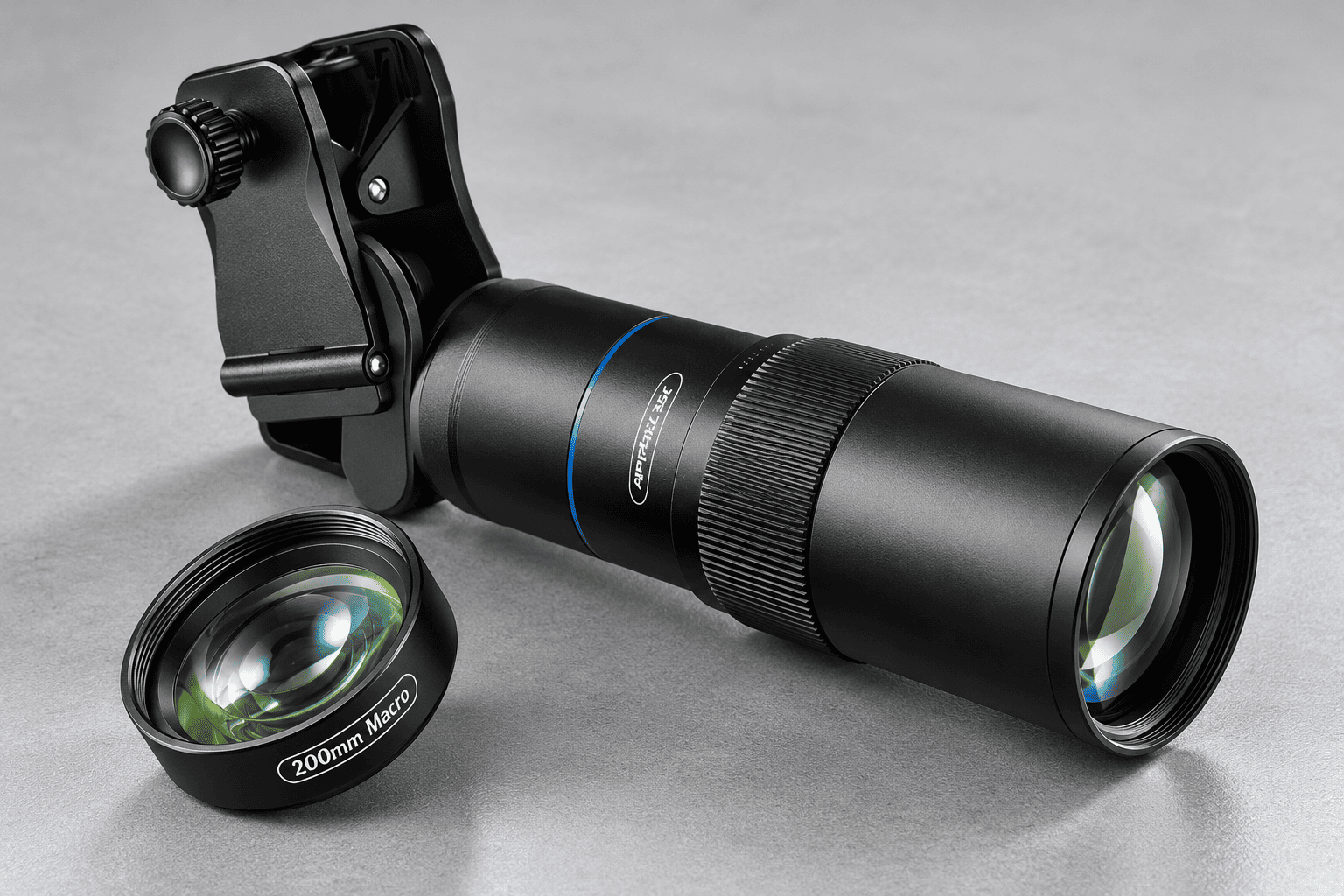
The APEXEL 10X Tele-Macro Pro Dual Lens makes sense if you regularly struggle to photograph distant subjects with your smartphone. At the listed price of $79.98, it offers a 10x fixed telephoto attachment alongside a macro lens for close-up photography.
Unlike digital zoom, its telephoto function uses an external optical system to magnify distant subjects before the image reaches the phone’s camera.
APEXEL advertises a 480 mm equivalent telephoto focal length, ED low-dispersion glass, multilayer optical coatings, and a manual focusing mechanism. The lens weighs approximately 145 grams and supports compatible smartphones through a clip or suitable mounting case.
Those specifications make it interesting for outdoor photography, distant architecture, and stationary subjects that your phone’s normal camera cannot frame closely enough.
The macro function gives the kit another purpose. You can switch to close-up photography rather than using the telephoto attachment exclusively for distant scenes.
Some features worth considering include:
- 10x telephoto magnification: Provides substantial optical reach for distant subjects.
- Macro attachment: Supports close-up photographs of small details.
- ED optical glass: Intended to reduce unwanted color fringing.
- Manual focus: Gives you direct control over focusing the telephoto image.
- 145-gram construction: Adds noticeable weight but remains relatively portable.
- 37 mm filter support: Allows compatible photographic filters to be attached.
- Universal mounting options: Supports various phones, subject to physical compatibility.
The biggest compromise is handling. At 10x magnification, even small movements become obvious, so a stable grip or tripod can make a considerable difference.
An independent review by Digital Camera World found useful image quality and versatility but noted difficult clip alignment, visible edge color fringing, and shaky handheld shooting at high magnification.
The attachment also requires careful setup. You may need to prevent your phone from automatically switching cameras, particularly when its software detects unusual focusing conditions.
I’d consider the APEXEL if you want genuine optical telephoto reach and don’t mind spending additional time setting up each shot. It’s particularly relevant when your current smartphone relies heavily on digital cropping for distant photography.
However, I wouldn’t expect it to match every aspect of a dedicated interchangeable-lens telephoto camera.
2
Ailun 3-in-1 Phone Lens Review: Best for Budget Photography

The Ailun 3-in-1 Clip-On Phone Lens Kit takes a very different approach. At the listed price of $6.98, it provides three camera accessories for experimenting with framing and close-up photographs.
However, it isn’t a telephoto lens kit, and that’s important for this comparison.
The package includes a 180-degree fisheye lens, a 0.65x wide-angle attachment, and a 10x macro lens. The macro magnification is designed for small objects photographed at close distances, not for making distant subjects appear ten times closer.
Ailun’s product information describes a universal-style clip mount, optical glass elements, and lightweight construction intended for smartphone photography.
The wide-angle attachment can help fit more of a room, landscape, or group into the frame. The fisheye lens offers exaggerated perspective and curved lines, which can be useful for creative photographs.
The macro lens is especially interesting if you enjoy photographing flowers, textures, small objects, or everyday details.
Here’s what the kit offers:
- 180-degree fisheye lens: Produces a strongly curved, ultra-wide perspective.
- 0.65x wide-angle lens: Expands the captured field of view.
- 10x macro attachment: Supports extreme close-up photography.
- Clip-on mounting system: Attaches to compatible smartphone cameras.
- Compact construction: Easier to carry than larger telephoto attachments.
- Low purchase price: Provides several photographic effects for under $10.
There are limitations worth understanding before buying.
The macro lens has a very short recommended working distance, around 1–2 cm according to available product instructions. That makes it suitable for tiny stationary subjects but less practical for moving insects or objects you cannot approach closely.
The clip may also struggle with large camera bumps or unusual smartphone camera arrangements. You should check your phone’s physical compatibility rather than assuming a universal label guarantees a perfect fit.
And because these are inexpensive optical attachments, I’d keep expectations reasonable regarding edge sharpness, distortion, and reflections.
I’d consider the Ailun kit if you’re curious about different photographic perspectives and want an inexpensive way to experiment.
Just don’t buy it expecting improved long-distance zoom. Its 10x macro lens and APEXEL’s 10x telephoto function serve completely different purposes.
APEXEL vs Ailun: Which Lens Kit Should You Choose?
The decision becomes straightforward once you identify what you’re trying to photograph.
APEXEL is the more relevant option when your subject is far away. Ailun makes more sense when you want to experiment with wide scenes, unusual perspectives, and close-up photography.
Here are the practical differences:
- For distant wildlife and architecture: APEXEL provides optical telephoto magnification.
- For concerts and outdoor events: APEXEL offers greater reach, although movement and lighting can still be challenging.
- For flowers and small objects: Both include macro capabilities, but their working distances differ substantially.
- For wide landscapes and group photos: Ailun provides a 0.65x wide-angle attachment.
- For creative fisheye effects: Ailun includes a dedicated 180-degree fisheye lens.
- For the lowest cost: Ailun is significantly cheaper at $6.98.
- For serious telephoto experimentation: APEXEL offers the more suitable optical system.
The roughly $73 price difference reflects the very different products you’re getting.
I wouldn’t choose Ailun as a cheaper substitute for a telephoto lens because it doesn’t provide the same function. If you don’t need distant magnification, though, there’s little reason to spend more simply because APEXEL has a larger lens.
What Actually Matters Before Buying a Phone Zoom Lens?
Before purchasing a lens attachment, check whether it solves a limitation your current camera genuinely has.
Some modern smartphones already include capable telephoto cameras, and their computational zoom can produce excellent images at moderate magnifications.
An external attachment becomes worthwhile when it gives you a field of view or focusing capability you cannot easily achieve with your built-in camera.
I’d check these details first.
- Optical magnification vs macro magnification: A 10x telephoto lens magnifies distant subjects. A 10x macro attachment is intended for nearby objects. The numbers aren’t directly interchangeable.
- Physical compatibility: Check your phone’s camera placement, camera bump, case thickness, and the attachment’s mounting system. Poor alignment can cause dark corners and reduced sharpness.
- Lens quality: Look for reliable information about sharpness, distortion, and chromatic aberration rather than trusting magnification numbers alone.
- Image stabilization: Strong telephoto magnification exaggerates movement. A tripod or stable support may be necessary, particularly when recording video.
- Manual focusing: Some external lenses require careful focus adjustments. This can provide useful control but also make spontaneous photography more difficult.
- Portability: Large telephoto attachments require more storage space and setup time. Small macro and wide-angle clips are generally easier to carry.
You should also consider whether your phone automatically switches between cameras. That behavior can interfere with attachments intended for one specific lens.
How to Get Sharper Zoom Photos Without Buying Accessories
Before purchasing an external lens, try improving the way you use your existing smartphone camera.
Small changes in lighting, stability, and magnification can make a noticeable difference, particularly with high-resolution modern sensors.
A few habits are worth developing:
- Use your phone’s native telephoto setting: If your device has a dedicated telephoto camera, start with its optical focal length.
- Avoid maximum digital zoom: Extreme cropping often produces less useful detail than moderate magnification.
- Photograph in good light: Bright conditions help preserve sharpness and reduce image noise.
- Keep your phone steady: Rest your elbows against a stable surface or use a small tripod.
- Clean the camera lens: Fingerprints can reduce contrast and create unwanted glare.
- Capture at high resolution when useful: Additional native pixels may provide more flexibility for later cropping.
- Try cropping after taking the photograph: This can give you more control over composition without relying on aggressive live zoom.
For moving subjects, shutter speed also matters. A photograph can look soft because of subject movement even when the lens and sensor are capable of recording plenty of detail.
If you’re photographing a distant subject in poor lighting, don’t assume digital zoom is the only problem. Motion blur and insufficient light may be limiting the final image just as much.
Final Thoughts: Optical Zoom Is Better for Reach, but Digital Zoom Still Has Its Place
Optical and digital zoom both make subjects appear closer, but they accomplish that in different ways. Optical magnification changes the image through physical lenses, while digital zoom crops and enlarges the information your camera has already captured.
For distant subjects where fine detail matters, a good optical telephoto system generally has an advantage. Digital zoom remains perfectly useful for modest framing adjustments, especially on modern high-resolution smartphones.
If you want to add optical telephoto reach to a compatible smartphone, I’d consider the APEXEL 10X Tele-Macro Pro. Its 10x telephoto capability is relevant for distant subjects, while the additional macro function provides another photography option.
If your goal is inexpensive creative photography rather than long-distance zoom, the Ailun 3-in-1 Lens Kit makes more sense. Its wide-angle, fisheye, and macro attachments offer different perspectives for just $6.98.
Remember, Ailun’s 10x macro feature isn’t the same as 10x telephoto magnification.
For most everyday photographs, I’d start with your phone’s native cameras and use digital zoom moderately. When you consistently need more reach or a specialized perspective, a suitable optical attachment becomes a much more meaningful purchase.