Roomba is the better choice if you value an established robot-vacuum brand, straightforward controls, and a wide selection of replacement parts. Eufy generally gives you more cleaning features for the price, especially if you want strong suction, advanced mopping, and an all-in-one dock without moving into the most expensive category.
Affiliate Disclaimer
This website participates in affiliate programs. We may earn a commission
when you purchase products through links on this page, at no additional
cost to you. Our recommendations are based on independent research and
honest opinions.
That does not mean every Roomba is better supported or every Eufy is a bargain. Both companies sell basic vacuum-only robots as well as advanced vacuum-and-mop systems, so the specific model matters more than the logo. Your flooring, pets, floor plan, and tolerance for maintenance should guide the final decision.
Roomba and Eufy Take Different Approaches
Roomba is the robot-vacuum name most people recognize. iRobot introduced the original Roomba more than two decades ago, and the company has built an extensive lineup around automated floor cleaning. Its current range includes simple vacuum-only robots, self-emptying models, and advanced combo systems that vacuum, mop, wash their pads, and manage debris at the dock.
Eufy is part of Anker and entered the category with relatively affordable RoboVac models. It has since expanded well beyond basic random-navigation robots. Current Eufy models can include LiDAR mapping, object recognition, self-emptying stations, mop washing, heated drying, automatic water refilling, and high stated suction ratings.
In practical terms, Roomba often sells familiarity and a mature floor-cleaning ecosystem. Eufy tends to compete by including more hardware features at a given price. The better approach depends on whether you want proven simplicity or the longest feature list your budget can accommodate.
Cleaning Performance on Hard Floors
Both brands can handle the dust, crumbs, hair, and light debris that collect on hardwood, tile, laminate, and vinyl floors. The real difference appears when you compare individual brushes, suction settings, navigation patterns, and how well the robot reaches edges.
Roomba has traditionally focused on brush design and floor contact rather than leading with large suction numbers. Many models use rubber rollers that are relatively easy to clean when hair wraps around them. Newer Roomba combo models add spinning mop pads for handling dried marks and everyday dirt on sealed hard floors.
Eufy often advertises suction in pascals, particularly on its higher-end models. A strong number can be useful, but it should not be treated as a complete measurement of cleaning ability. Brush agitation, airflow, floor contact, navigation, and the number of passes can all affect how much debris a robot actually removes.
For either brand, expect the best results when the robot runs frequently. Robot vacuums are designed to prevent dirt from accumulating, not replace every part of a traditional deep-cleaning routine.
Cleaning Carpets and Pet Hair
Pet hair is one of the strongest reasons to own a robot vacuum. Running the robot every day can keep loose fur from building up along walls, under furniture, and across low-pile rugs. However, homes with several shedding animals still need occasional manual cleaning.
Roomba’s rubber-brush designs can be helpful with hair because there are fewer conventional bristles for fur to wrap around. Performance varies across the lineup, though. A basic Roomba and an advanced self-emptying model should not be expected to provide the same carpet cleaning or navigation.
Eufy offers several models built around high suction and detangling features. For example, the Eufy X10 Pro Omni is rated by its manufacturer at 8,000 Pa and uses a floating roller brush designed for carpets and pet debris. Eufy also positions this model specifically for homes with pets.
Before choosing either brand, consider your carpet depth. Robot vacuums generally perform best on hard flooring and low-to-medium-pile carpet. Thick rugs, loose tassels, dark patterns, and high thresholds may still cause trouble, regardless of the brand.
Navigation and Mapping
A robot vacuum becomes far more useful when it understands the layout of your home. Accurate mapping lets you clean a particular room, create no-go zones, schedule different areas, and send the robot back to a missed section without repeating the entire floor.
Current Roomba models may use LiDAR, cameras, or a combination of sensors, depending on the series. The Roomba Plus 405, for example, uses ClearView LiDAR to create a map and clean in organized rows, including in low-light conditions. More advanced models can add camera-based object recognition.
Many newer Eufy models also use LiDAR for rapid mapping. Its more advanced systems may combine mapping with cameras or infrared sensors to recognize cords, shoes, toys, and other objects. This can reduce the amount of preparation needed before a scheduled run.
Even then, no robot should be trusted blindly around charging cables, socks, liquid spills, pet waste, or fragile objects. Spend a minute clearing the floor before the robot starts. That small habit can prevent an expensive and unpleasant problem.
Mopping Ability
Basic robot mops drag a damp cloth across the floor. They can collect fine dust and fresh marks, but they do not provide the scrubbing action most people expect from manual mopping. Better systems use rotating or rolling pads, apply downward pressure, and return to the dock for cleaning.
Both Roomba and Eufy now offer more capable mopping systems. The Roomba Plus 405 uses two spinning mop pads, while its AutoWash dock washes, refreshes, and dries them. It also handles clean and dirty water as part of its automated routine.
Eufy’s X10 Pro Omni uses dual spinning mop pads rated at 180 rotations per minute with 1 kilogram of downward pressure. Its station can empty debris, wash and dry the pads, and refill the robot’s water tank. The more expensive Eufy S1 Pro takes a different approach with a rolling mop that is continuously refreshed while cleaning.
Advanced docks reduce daily work, but they do not eliminate maintenance. You still need to add clean water, empty dirty water, remove hair, wipe sensors, clean the dock tray, and replace worn parts.
Apps and Everyday Controls
The Roomba Home app and Eufy Clean app provide scheduling, room selection, cleaning history, maps, and maintenance information on supported models. The exact features depend heavily on the robot, so do not assume that every model from one brand has the same app controls.
Roomba’s experience is generally designed around clear cleaning jobs and room-based routines. Its established ecosystem can also make it easier to find setup information, consumable parts, and model-specific troubleshooting. Still, app performance and firmware updates can affect any connected appliance over time.
Eufy provides detailed cleaning controls on many of its advanced models. The X10 Pro Omni, for instance, lets you save recurring cleaning scenarios such as a full-home daily clean or a post-meal cleanup. This flexibility is useful if you want different suction, water, or room settings throughout the week.
Both brands require an account and Wi-Fi for their complete connected feature sets. Basic physical controls may still start or stop cleaning, but advanced mapping and scheduling usually depend on the app.
Privacy Deserves Some Attention
Robot vacuums create maps of your home, and some models use cameras for navigation or obstacle recognition. That makes account security and data handling worth considering, particularly if you buy a camera-equipped model.
Use a unique password, enable additional account protection when available, and keep the robot’s software updated. Review app permissions rather than allowing every request without reading it. You should also understand whether images are processed on the device, sent to a server, or stored in your account for troubleshooting.
A LiDAR-only model may appeal to you if you are uncomfortable placing a mobile camera inside the home. LiDAR still maps rooms and objects, but it does not capture ordinary visual images in the same way as a camera.
Dock Size and Ongoing Maintenance
An advanced dock takes up more room than the small charger supplied with a basic robot. Some all-in-one stations need clear space above and beside them so you can remove water tanks or debris bags. Measure the proposed location before ordering.
Self-emptying docks also create a brief burst of noise when transferring debris from the robot. The sound may only last several seconds, but it can be startling in a bedroom or near a sleeping child. Scheduling the robot during daytime hours usually solves this.
Roomba docks commonly use disposable debris bags, depending on the model. Many Eufy all-in-one stations also use bags. You will need to include bags, filters, brushes, mop pads, and cleaning fluid in the long-term cost rather than comparing only the initial purchase prices.
Eufy often provides more features at a lower starting price, but a complicated dock has more parts to clean. Roomba’s simpler models may require more frequent attention to the onboard bin but less dock maintenance. Decide which kind of work you would rather do.
Which Brand Offers Better Value?
Eufy usually has the advantage when value means getting the greatest number of functions for your budget. Its lineup includes several models with strong stated suction, capable obstacle avoidance, spinning or rolling mop systems, and automated docks at prices that compete aggressively with established brands.
Roomba becomes more compelling when value means brand familiarity, easily understood product families, accessible replacement parts, and a long history in robot floor care. Recent models have also become more competitive with LiDAR mapping, spinning mop pads, and multifunction docks.
A lower price is not automatically a better deal. A robot that frequently becomes stuck, misses rooms, or requires constant app troubleshooting provides poor value no matter how impressive its specifications appear. Look closely at feedback for the exact model, not the brand’s overall reputation.
Two Specific Alternatives for Different Homes
The brand comparison gives you a useful starting point, but a purchase has to come down to an individual machine. The two supplied products serve very different purposes and price points.
The Roomba Plus 405 is a complete vacuum-and-mop system with an automated washing dock. The Shark AV2501AE is a less expensive vacuum-only alternative with a bagless self-emptying base. Shark is not an Eufy product, but it is relevant if your real priority is automatic vacuuming rather than mopping.
1
iRobot Roomba Plus 405: Best for Automated Vacuuming and Mopping

The iRobot Roomba Plus 405 is designed for someone who wants more than daily surface vacuuming. It combines vacuuming with two spinning mop pads and uses an AutoWash dock to empty debris, manage water, wash the pads, and dry them after cleaning.
ClearView LiDAR maps the home and guides the robot in orderly rows, including when rooms are dark. You can use the app to clean specific rooms, create keep-out areas, adjust suction, and choose the amount of mopping liquid used. The robot can also recognize carpet and prevent its wet pads from mopping rugs when configured correctly.
According to iRobot, the dock can provide up to 75 days of automatic debris emptying and approximately four weeks of mopping and pad washing before routine attention, although actual intervals depend on your home and cleaning frequency. The dock also runs self-cleaning cycles and dries the pads to reduce the damp environment that can produce odors. iRobot’s product information explains these functions.
At the supplied price of $498, this model is for a home with substantial hard flooring and regular mopping needs. Its supplied 3.9-star rating suggests reading recent reviews carefully, particularly comments about the app, navigation, dock reliability, and maintenance.
Choose it if you want:
- Vacuuming and active mopping in one run
- LiDAR mapping
- Automatic debris emptying
- Mop washing and drying
- Less daily floor-care work
2
Shark AV2501AE AI Robot Vacuum: Best Value for Pet Hair and Vacuuming
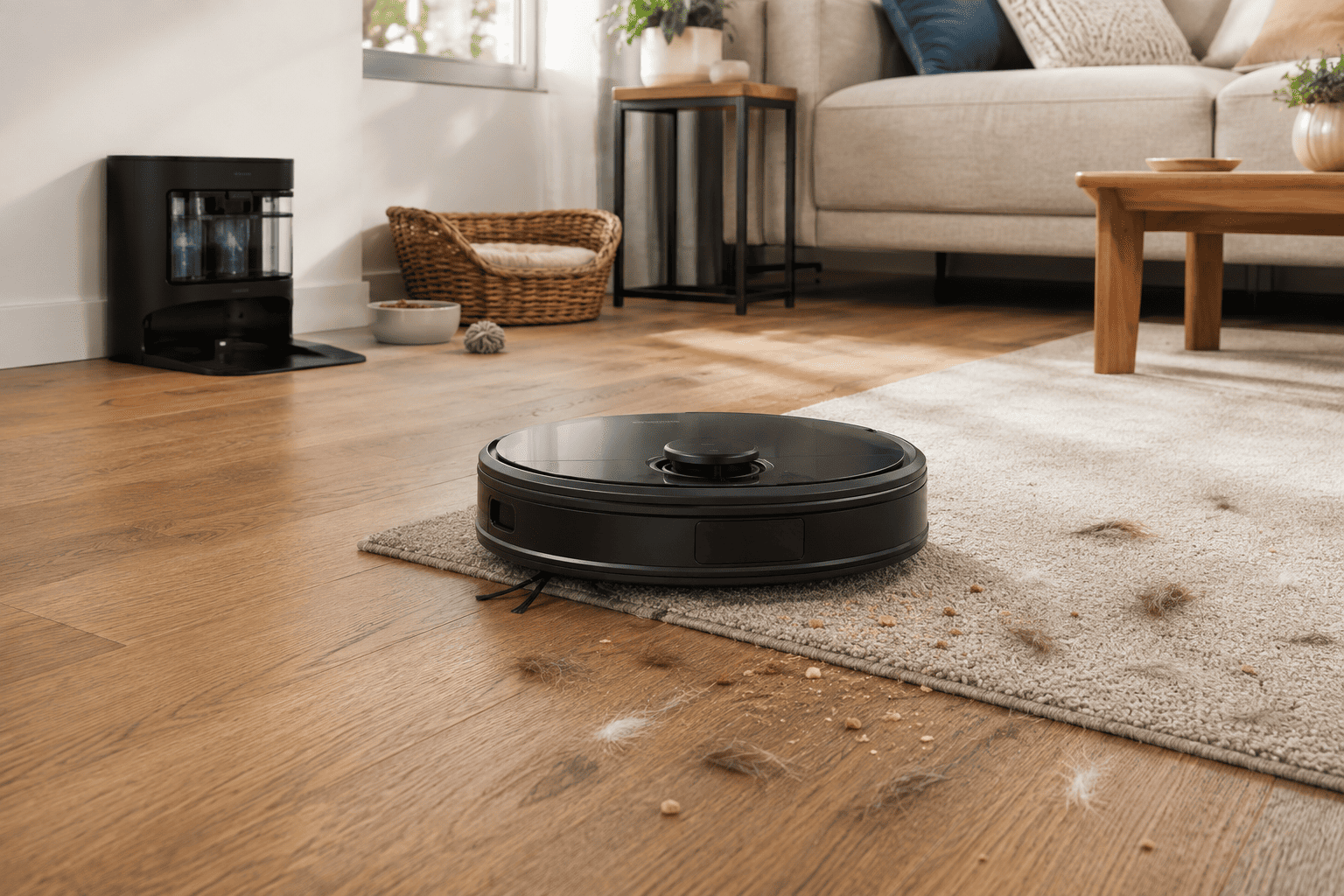
The Shark AV2501AE AI Robot Vacuum is a better fit when mopping is not important. It is a vacuum-only robot with 360-degree LiDAR navigation and a bagless self-emptying base, giving it a simpler job than the Roomba Plus 405.
Shark says the base can hold up to 60 days of debris. Because it is bagless, you avoid buying disposable dock bags, although emptying the container may release some dust. The base includes HEPA filtration that the manufacturer says captures 99.97% of particles down to 0.3 microns.
The robot maps the home, cleans in a methodical pattern, and supports room selection through the SharkClean app. Voice control is available through compatible Alexa and Google Assistant devices. Its brush system is designed to maintain contact across hard flooring and carpet, making it a practical option for everyday dust, crumbs, and pet hair.
At the supplied price of $299.99, it costs considerably less than the Roomba while still providing LiDAR mapping and automatic emptying. Its 4.0-star rating across approximately 17,900 reviews provides plenty of owner feedback to examine. Pay particular attention to recent comments about mapping, hair pickup, replacement parts, and app reliability.
Choose it if you want:
- Vacuuming without mopping
- A bagless self-emptying base
- LiDAR navigation
- Daily pet-hair control
- A lower purchase price
What to Check Before Spending Your Money
Your Flooring Mix
Hard-floor homes benefit most from a capable vacuum-and-mop system. If most rooms are carpeted, advanced mop washing may add cost and dock maintenance without providing much value. A vacuum-focused robot could be the smarter purchase.
Obstacles and Floor Clutter
LiDAR maps walls and furniture well, but small-object avoidance varies. Homes with cables, toys, socks, or pet bowls need stronger object detection or a quick floor check before every run.
Pet Hair and Allergies
Look beyond suction numbers. Brush design, filter quality, self-emptying method, and how easily you can remove wrapped hair all affect daily ownership. A bagged base may contain dust better, while a bagless base avoids replacement-bag costs.
Replacement-Part Costs
Filters, brushes, mop pads, dock bags, and batteries wear out. Check availability and prices before buying the robot. An inexpensive machine becomes frustrating when its correct consumables are constantly unavailable.
How Much Maintenance You Expect to Avoid
A multifunction dock saves time but still requires cleaning. If you dislike handling dirty water, a vacuum-only robot may be more pleasant to own. If manual mopping is the task you most want to reduce, an AutoWash or Omni-style station can justify its additional cost.
Roomba or Eufy: The Final Verdict
Eufy is worth your money if you want the greatest number of cleaning and dock features at a competitive price. Models such as the X10 Pro Omni are particularly appealing for pet hair, hard floors, and automated mopping. Just compare exact models carefully because Eufy’s lineup ranges from basic robots to much more advanced systems.
Roomba is the stronger choice if you prefer an established floor-care brand and want a broad selection of robots, parts, and support information. The Roomba Plus 405 is especially suitable for a mostly hard-floor home where automatic mopping, pad washing, and debris emptying will save meaningful time.
Of the two supplied products, choose the Roomba Plus 405 if mopping is a major priority and the $498 price fits your budget. Choose the Shark AV2501AE if you mainly need daily vacuuming and pet-hair control, and would rather pay $299.99 for a bagless self-emptying system. For a strict Roomba-versus-Eufy purchase, Eufy generally wins on features per dollar, while Roomba remains the safer fit for people who value familiarity and a long-established cleaning ecosystem.